
Do You Need a Wire Armature for Needle Felting?
Do You Need a Wire Armature for Needle Felting?
One of the questions I’ve been asked many times over the years is:
Do I need to build a wire armature before I start needle felting?
My answer is:
Not necessarily.
There are many ways to create a needle felted sculpture, and some artists love working over a complete wire armature.
I don’t.
My own technique developed through a lot of trial and error, including one memorable lesson involving some of my very first needle felted animals.

My Early Sculptures Taught Me a Lesson
When I first learned to needle felt, I was incredibly proud of everything I made.
Naturally, I gave some of those early sculptures to family members as gifts.
At the time, I thought they were wonderful.
Now when I see one sitting in a relative’s house, part of me wants to quietly take it home and fix everything I’ve learned to do differently since then.
But those early sculptures taught me a lot.
One of the most important lessons was about legs.
I had felted the animals very firmly, but after enough time passed, some of those unsupported legs began spreading apart.
One little dog I had made for my brother eventually couldn't stand properly at all.
That was when I realized that some sculptures needed a little more internal support.
My First Attempt at Adding Wire
I brought the dog home and decided I could repair him.
I found some baling wire on the farm and tried inserting it through one leg and into the body.
Getting the wire into the first leg wasn't too bad.
Getting it to make a turn inside the body and travel neatly down the second leg was another story.
It wasn't happening.
Eventually I cut one leg off, positioned the wire, and reattached the leg around it.
The repair worked, but I discovered something else:
I did not enjoy felting around wire.
Not even a little.
Soon afterward, I began seeing other needle felters building complete wire armatures before adding any wool.
That technique made sense, but I already knew it wasn't how I wanted to work

What Is a Wire Armature?
An armature is simply an internal framework that supports a sculpture.
In needle felting, artists often bend wire into the basic shape of the body, legs, neck, and sometimes even the tail before wrapping and felting wool around it.
A full armature can be useful if you want:
- Very thin legs or other delicate structures
- A sculpture that can be repositioned
- Extra structural support
- A framework to establish proportions before adding wool
Some needle felters love working this way.
I prefer something different.

I Build the Wool First
I like sculpting directly with wool.
Rather than beginning with a wire skeleton, I build and firm the main body shape first.
That gives me the freedom to change proportions as I work.
If the back needs to be longer, I add wool.
If the chest needs more depth, I build it out.
If the head isn't quite right, I reshape it.
I'm not trying to make my wool conform to a wire structure I created at the beginning.
For the way I sculpt animals, that freedom is important.
Where I Do Use Wire
I eventually developed a compromise that works very well for me.
I use wire only where the sculpture needs structural support.
Most often, that means the legs.
Once the body is very firm and I'm ready to add the legs, I insert wire through the body where the legs will be positioned.
Then I build the legs by wrapping wool around the wire and felting it into shape.
There is still some felting around wire involved, but much less than if I had built the entire animal over an armature.
The wire gives those narrow legs the support they need while allowing me to create most of the sculpture entirely from wool.
Whenever you use wire inside a sculpture, make sure all ends are securely enclosed in wool and aren't left exposed.
Not Every Sculpture Needs Wire
I don't automatically put wire into every animal I make.
A bunny sitting on its haunches, for example, has a very different structure from a tall animal standing on four narrow legs.
The same is true for a compact animal with a large area resting on the surface.
When wool is felted very firmly, it can be remarkably strong.
So before adding wire, I ask:
Does this part of the sculpture actually need additional support?
If the answer is no, I would rather leave it out.
Why I Don't Make My Sculptures Fully Posable
Another reason artists use full wire armatures is to make sculptures posable.
That's not especially important to me.
I spend a tremendous amount of time studying an animal's stance and deciding exactly how I want the finished sculpture to stand.
The position of the head, legs, neck, and body are all part of the sculpture.
Growing up around livestock taught me how much an animal communicates simply by the way it carries itself.
A proud stance feels different from a timid one.
A relaxed animal stands differently from an alert animal.
Those details are part of what gives a sculpture personality.
Once I've created that pose, I want it to stay that way.
There Isn't One Correct Way
Needle felting is full of different techniques.
Some artists build beautiful sculptures over complete wire armatures.
Some use very little wire.
Some use none at all.
My method developed from the way I like to sculpt and from the problems I encountered along the way.
For me, the best solution has been:
Use wool for the sculpture and wire only where the structure needs it.
That gives me the freedom I want while I'm sculpting without sacrificing support in delicate areas like legs.
So, Do You Need a Wire Armature?
Sometimes.
You don't necessarily need to build an entire wire skeleton before you begin needle felting.
Think instead about what your particular sculpture needs.
A small, compact animal may need no wire whatsoever.
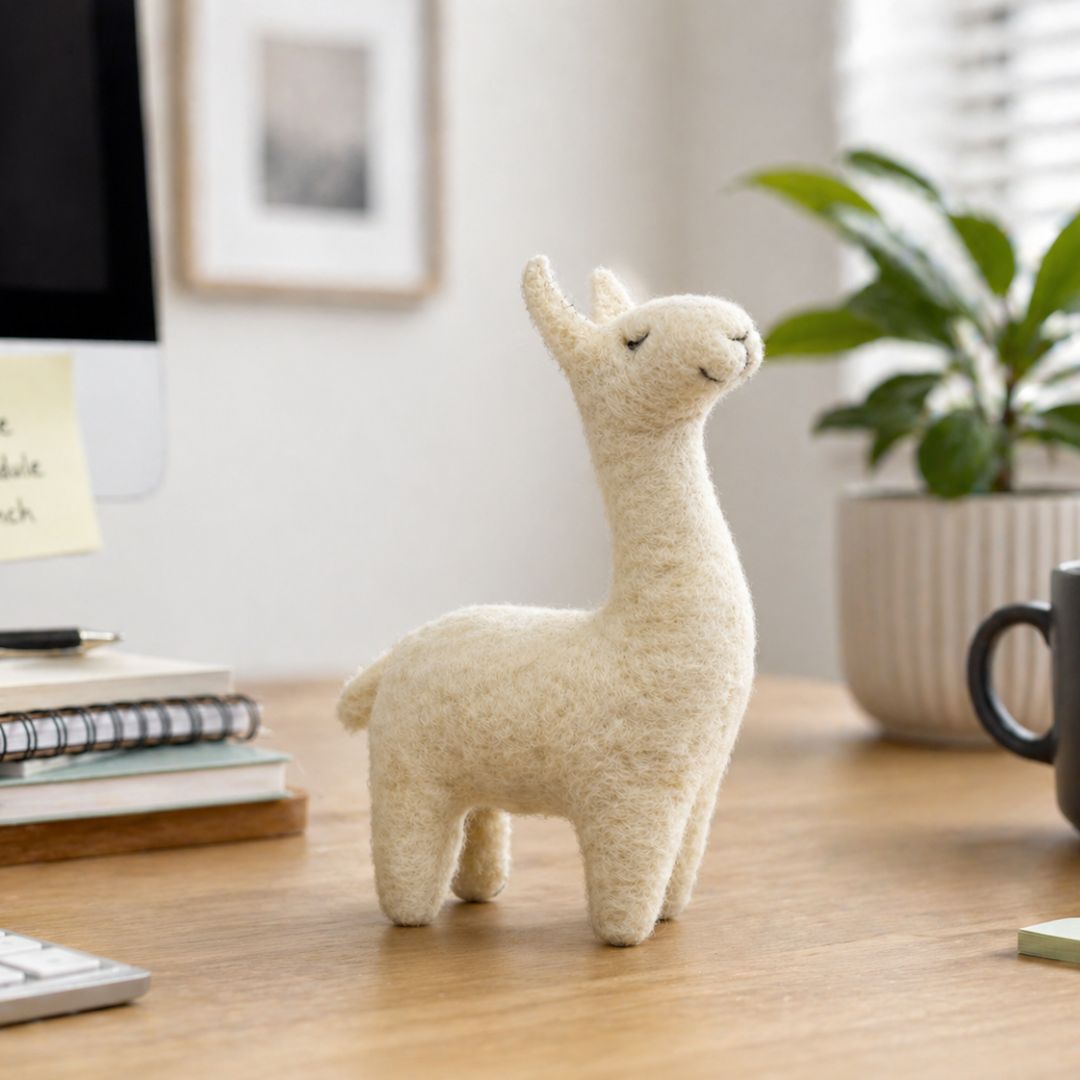
A tall animal standing on slender legs may benefit greatly from internal support.
And a sculpture designed to be completely posable may call for a full armature.
There isn't one rule that works for every project.
That's one of the things I love about needle felting.
You can learn different techniques, experiment with them, and eventually develop the method that makes the most sense for the way you want to sculpt.
Lorem ipsum dolor sit amet, consectetur adipiscing elit, sed do eiusmod tempor incididunt ut.




Read more