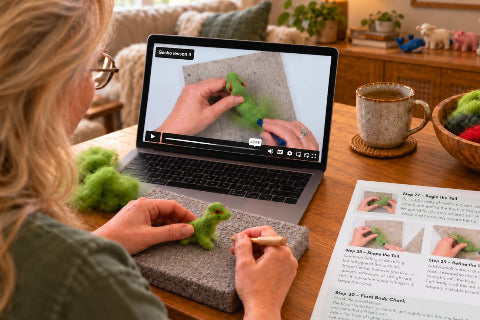

Needle Felting With Shetland Wool: How Does It Really Felt?

One of the reasons I started my Needle Felting Through the Sheep Breeds series was because I wanted to answer a question I was asked over and over:
What breed of wool is best for needle felting?
For years, my answer had always been Romney.
That was the wool I knew best, and it happened to work beautifully for the firm three-dimensional sculptures I like to create. But I wanted to try other breeds for myself rather than simply repeat what I already knew.
So I began an experiment: needle felt a sheep using wool from its own breed and pay close attention to how that fiber behaved.
This time, I worked with Shetland wool.
And Shetland taught me a very important lesson:
Knowing the breed name isn't always enough.
Shetland Wool Has Incredible Natural Color
The first thing that drew me to Shetland wool was the color.
Shetland sheep are known for an extraordinary range of natural shades—whites, grays, blacks, browns, fawns, and colors in between.
Traditional Shetland color names include:
- White
- Black
- Gray
- Light gray
- Shaela
- Emsket
- Moorit
- Fawn
- Mioget
- Musket
- Dark brown
For someone who enjoys creating realistic animals, that natural variation is exciting.
Dyed wool can be beautiful, but naturally colored fleece has subtle variation that can be difficult to reproduce with dye.
I first became fascinated by Shetland colors when my daughter Libbie knitted a Rams and Yowes blanket using Shetland yarn. The range of natural shades was a huge part of what made the finished piece so beautiful.

One Breed Can Produce Very Different Fleece
Shetland was also a great reminder that there can be considerable variation within a breed.
Some Shetland fleeces are relatively even and fine, while others have a more obvious double coat with longer, coarser fibers mixed with the softer wool.
That makes a big difference when you're needle felting.
For the way I sculpt, I generally prefer wool that is fairly consistent throughout. Long, coarse guard hairs don't readily disappear into a firm felted surface, so they can end up sticking out of the finished sculpture.
They can certainly be removed as you work.
I just don't particularly enjoy doing it.
My Shetland Wool Experiment
For this project, I purchased Shetland wool from several different sources in the United States and intentionally tried a variety of natural colors.
That gave me a better sense of just how much Shetland wool can vary.
Some of the fiber contained noticeable coarse hairs.
Some had been commercially prepared into a smooth fiber preparation.
Other wool had simply been washed and left much closer to its natural lock structure.
And surprisingly, those preparations did not all felt the same.

The Smoothly Prepared Wool Gave Me Trouble
The black wool I needed for much of the sculpture had been processed into a very smooth preparation.
It felt somewhat wiry to me, didn't have much obvious crimp, and took considerably more work to felt than I expected.
I could eventually get the results I wanted, but it was slower and more frustrating than working with the wool I normally use.
That wool wasn't necessarily poor-quality fiber.
In fact, I thought it would probably make very nice spinning fiber.
It simply wasn't particularly well suited to the job I was asking it to do.
That's an important distinction.
The Less-Processed Wool Felted Better
The Shetland wool I purchased washed but relatively unprocessed behaved much better under my felting needle.
I especially liked using it for the sheep's outer coat, where I could take advantage of its natural texture.
That was another good lesson from this experiment:
Fiber preparation can matter almost as much as breed.
Two bags labeled “Shetland wool” may give you very different results depending on which part of the fleece they came from and how the wool was processed.
Those Coarse Hairs Can Be a Nuisance
Some of the Shetland fiber I tried contained longer, coarser hairs that didn't want to felt into the sculpture.
You can see them poking through the surface as you work.
They aren't impossible to deal with. I simply pull them out when necessary.
But for the smooth, firm animal sculptures I like to create, I prefer not to have them there in the first place.
On the other hand, those very same fibers might be useful if you're intentionally trying to create a shaggy or textured surface.
Again, it comes back to what you want the wool to do.
Where Shetland Really Excels for Me
The natural colors are the standout.
If I were creating an animal and wanted subtle, realistic shades of gray, brown, black, or cream, I would absolutely consider Shetland.
Its color range gives you opportunities for natural-looking coats without needing to dye the fiber.
And if I found a Shetland fleece with the texture and preparation I wanted for sculptural felting, I'd be very interested in using it again.
Is Shetland Good for Needle Felting?
My answer is:
It can be—but ask questions before you buy it.
Rather than simply asking, “Is this Shetland?” I would want to know:
- Is the fleece fairly uniform or obviously double coated?
- Are there lots of coarse guard hairs?
- How crimpy is it?
- Has it been carded, combed, or left in locks?
- Is the seller familiar with needle felting?
- Can I purchase a small amount to test first?
If you find Shetland that felts exactly the way you like, remember where you bought it.
The next bag labeled “Shetland” may not behave the same way.
What I Like About Shetland Wool
- Beautiful range of natural colors
- Widely available
- Can have wonderful natural texture
- Excellent for realistic coat colors
- Some preparations felted quite nicely
What I Found Challenging
- Considerable variation from one fleece to another
- Some fiber contained coarse hairs that wouldn't felt readily
- Smoothly prepared fiber I tried was slower to needle felt
- Buying by breed name alone didn't tell me enough about how it would perform
What Shetland Taught Me
Of all the things I learned during this particular breed experiment, this may be the most important:
Don't judge felting wool by breed alone.
Breed matters.
But so do the individual sheep, the fleece type, which fibers were included, and how that wool was processed.
Shetland gave me some frustrating fiber and some wool I really enjoyed using—all under the same breed name.
That is exactly why I started this series.
The more breeds I put under my needle, the more I understand what characteristics make wool work well for the type of needle felting I do.
And sometimes the biggest lesson isn't whether a breed is “good” or “bad.”
It's learning what questions to ask before buying the wool.
Lorem ipsum dolor sit amet, consectetur adipiscing elit, sed do eiusmod tempor incididunt ut.


