Needle Felting for Beginners: Questions You’ve Always Wanted to Ask
I remember what it feels like to be the “new kid” in a group—everyone seems to know what’s going on except you.
Ever felt that way?
Puns aside, learning a new craft can be intimidating. There are unfamiliar tools, new terminology, different types of wool, and people talking about things like gauges, armatures, sliver, and barbs as if everyone automatically knows what they mean.
Nobody does at first.
Every needle felter starts as a beginner.
So if you’re curious about needle felting but aren’t quite sure where to begin, here are answers to some of the questions I hear most often.

What Is Needle Felting?
Needle felting is the process of shaping wool using a special barbed needle.
As the needle moves in and out of the wool, tiny barbs catch the fibers and tangle them together. The more you felt an area, the firmer and more defined it becomes.
You can create flat designs, ornaments, decorations, and all kinds of three-dimensional sculptures.
My own favorite subjects are animals. I love taking a loose pile of wool and slowly turning it into something with expression and personality.
Is Needle Felting Hard to Learn?
The basic motion is very simple.
The challenge comes in learning how to control the wool and create the shapes you want.
That takes practice—but you certainly don't need previous art experience to begin.
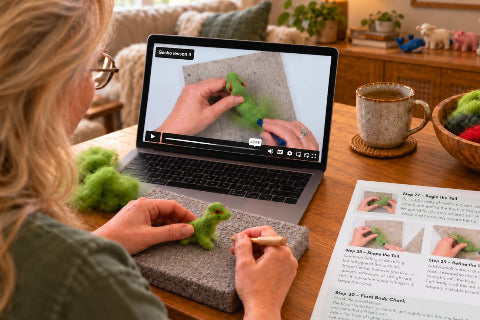
I recommend starting with a small, beginner-friendly project. You'll learn how firmly to felt, how to join pieces together, how to add wool, and how to refine a shape.
Once those basic skills begin to feel natural, you can move into more detailed projects.
What Do I Need to Get Started?
You really don't need very much:
- Wool
- Felting needles
- A felting pad or cushion
- A project or set of instructions
That's one reason I created needle felting kits in the first place.
When I was learning, figuring out how much wool I needed and which supplies to buy was one of the frustrating parts. A good beginner kit removes that guesswork so you can concentrate on learning to felt.

What's Different About a Felting Needle?
A felting needle isn't the same as a sewing needle.
Tiny barbs along the shaft catch the wool fibers as you poke into the wool. Those barbs are what allow loose fiber to gradually become firm felt.
Felting needles are also very sharp and fairly fragile.
The best habit you can develop is to poke the needle straight into the wool and pull it straight back out. Bending or twisting the needle while it's embedded in the wool is one of the easiest ways to break it.
Different needle shapes and gauges are useful for different jobs, but beginners don't need to understand every needle before getting started.
A couple of good-quality felting needles will take you a long way.
Do Felting Needles Wear Out?
Yes.
A felting needle can gradually become less effective after a lot of use. You may notice that you're poking more but accomplishing less.
And sometimes, of course, needles simply break.
I always recommend keeping extras nearby. There is nothing worse than settling in to felt and breaking your only needle!
Does the Kind of Wool Matter?
Absolutely.
Different breeds of sheep produce very different wool, and those fibers don't all behave the same way when needle felted.
I especially like the Romney-based wool from our own flock because it firms up nicely and holds the shapes I want when creating three-dimensional sculptures.
Very fine wool such as Merino can also be needle felted, but I find that it often takes longer to become as firm as I prefer for sculptural work.
Today, we're able to follow much of our wool through the entire process—from our sheep here in North Dakota through our own fiber mill and eventually onto the felting mat.
That has taught me a tremendous amount about what makes wool enjoyable to needle felt with.
How Much Wool Will I Need?
Usually less than beginners expect!
Wool can be built up gradually, and the amount required depends on the size and firmness of your finished sculpture.
If you're working from a Bear Creek Felting kit, I've already measured the wool you need for that particular project.
As you gain experience and begin designing your own sculptures, you'll develop a much better feel for how much fiber you'll need.
Do I Need a Needle Holder?
No.
I do a tremendous amount of my detailed work with a single felting needle.
Needle holders can still be useful. A multi-needle tool, for example, can help cover larger areas more quickly.
But don't feel that you need to buy every tool you see before you're allowed to begin.
Start simple.
You'll quickly discover which tools fit the way you like to work.
What Should My First Project Be?
Choose something with relatively simple shapes.
A sheep, snowman, penguin, or another beginner project lets you practice the fundamentals without immediately worrying about complicated armatures, long legs, intricate markings, or advanced anatomy.
Your first project isn't supposed to prove how talented you are.
It's supposed to teach you.
And chances are you'll learn quite a bit from it.
What Comes After Beginner Projects?
That's when things really start getting fun.
You can learn to create more realistic proportions, use wire in standing animals, add detailed faces, work with different types of wool, and tackle larger sculptures.
You may even begin designing projects of your own.
If you'd like structured instruction as your skills grow, the Bear Creek Needle Felting Academy includes step-by-step courses for different skill levels along with a community of felters who are learning and creating together.
But don't worry about everything that's ahead yet.
Get some wool.
Pick up a needle.
Make your first shape.
Every needle felter you admire started in exactly the same place.
Lorem ipsum dolor sit amet, consectetur adipiscing elit, sed do eiusmod tempor incididunt ut.


