
Do Felting Needles Wear Out?
When I first started needle felting, the needles I used had been given to me by a friend.
I used those same needles for a very long time—until I eventually broke or lost them and had to buy replacements.
I still remember using a brand-new felting needle after working with my old ones for months.
I couldn't believe the difference.
Suddenly the wool seemed to move faster. The needle grabbed the fibers more efficiently. Felting felt easier again.
That was when I realized something I hadn't really considered before:
Felting needles can lose effectiveness with use.

Yes, Felting Needles Can Become Less Efficient
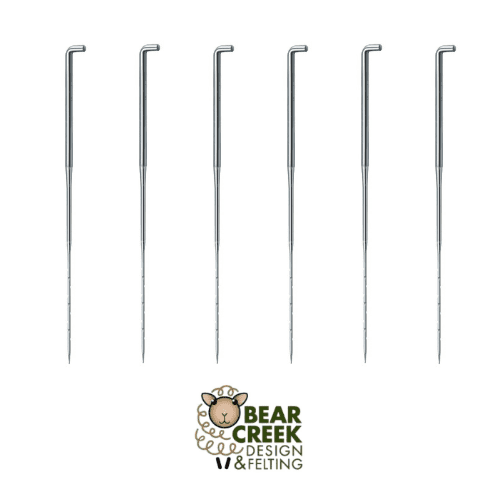
A felting needle works because of the tiny barbs cut into its shaft.
Those barbs catch wool fibers as the needle moves through them, helping move and entangle the fibers so the wool becomes denser and firmer.
After a lot of use, a needle may no longer seem to grab the fiber as aggressively as it once did.
You may notice yourself poking and poking without getting the same result.
The change can happen gradually, which is why it is easy not to notice.
You simply start working harder.
How Can You Tell if Your Needle Is Getting Dull?
One of the easiest tests is simply to try a fresh needle.
If the new needle suddenly feels dramatically more effective, chances are the old one had lost some of its efficiency.
Other signs I notice include:
- It takes noticeably longer to firm the wool
- The needle doesn't seem to move fiber as well
- You find yourself poking the same area over and over
- A needle that once felt aggressive now seems surprisingly gentle
- Felting suddenly feels like more work than it should
Before blaming the needle, though, remember that wool matters too.
Different breeds and preparations can behave very differently under the same needle.
Sometimes It’s the Wool, Not the Needle
This is where things get a little tricky.
If you switch to a very fine, smooth, or unusually coarse wool, it may felt differently even with a perfectly good needle.
I see this all the time when experimenting with different sheep breeds.
Some wool grabs quickly.
Some takes considerably more work.
Even two fleeces from the same breed can behave differently.
So if your felting suddenly slows down, ask yourself:
Did I change wool—or am I still using the same needle I’ve been using for hours and hours?
Sometimes the easiest way to find out is to compare your old needle with a fresh one on the same piece of wool.
My Personal Five-Hour Rule
Because I needle felt so much, I eventually developed a simple routine.
For my own work, I generally switch to a fresh primary needle after roughly five hours of heavy use.
That isn't a manufacturer's rule or an exact lifespan for every felting needle.
It's simply what works well for me.
If I've spent most of an afternoon felting with one needle, I may start the next session with a fresh one rather than waiting until I become frustrated with it.
Felting needles are a relatively small part of the cost of making a sculpture, and I would rather replace a tired needle than spend extra hours fighting with one that isn't moving wool efficiently.
Don't Confuse a Dull Needle With the Wrong Needle
Sometimes the needle isn't worn out at all.
It may simply be the wrong needle for that stage of your project.
A heavier needle can be useful when you're building and firming a shape.
A finer needle may be better once the sculpture becomes dense and you're refining the surface.
Specialty needles also behave differently because of their shape and barb placement.
So before throwing a needle away, consider whether you simply need a different type for the job.
Bent Needles Should Be Replaced
A needle that is merely less efficient is one thing.
A bent felting needle is another.
Felting needles are brittle. If one becomes bent, I replace it rather than trying to straighten it and continue using it.
A damaged needle is more likely to snap while you're working.
Always remember:
Straight in. Straight out.
That simple habit helps protect your needles and your fingers.
Fresh Needles Can Make Felting More Enjoyable
Felting is already a slow process.
There is no prize for making it slower by hanging onto the same needle forever.
If you've been wondering why your wool suddenly seems difficult to felt, try a fresh needle before deciding you're doing something wrong.
Sometimes the difference is surprisingly obvious.
It certainly was for me.
And ever since discovering that, I've preferred to replace my heavily used needles before they become frustrating rather than waiting until they break.
A tiny tool can make a very big difference.