
How does a Felting Needle Work?
How Does a Felting Needle Work?

If you’re new to needle felting, the tool itself can look a little mysterious.
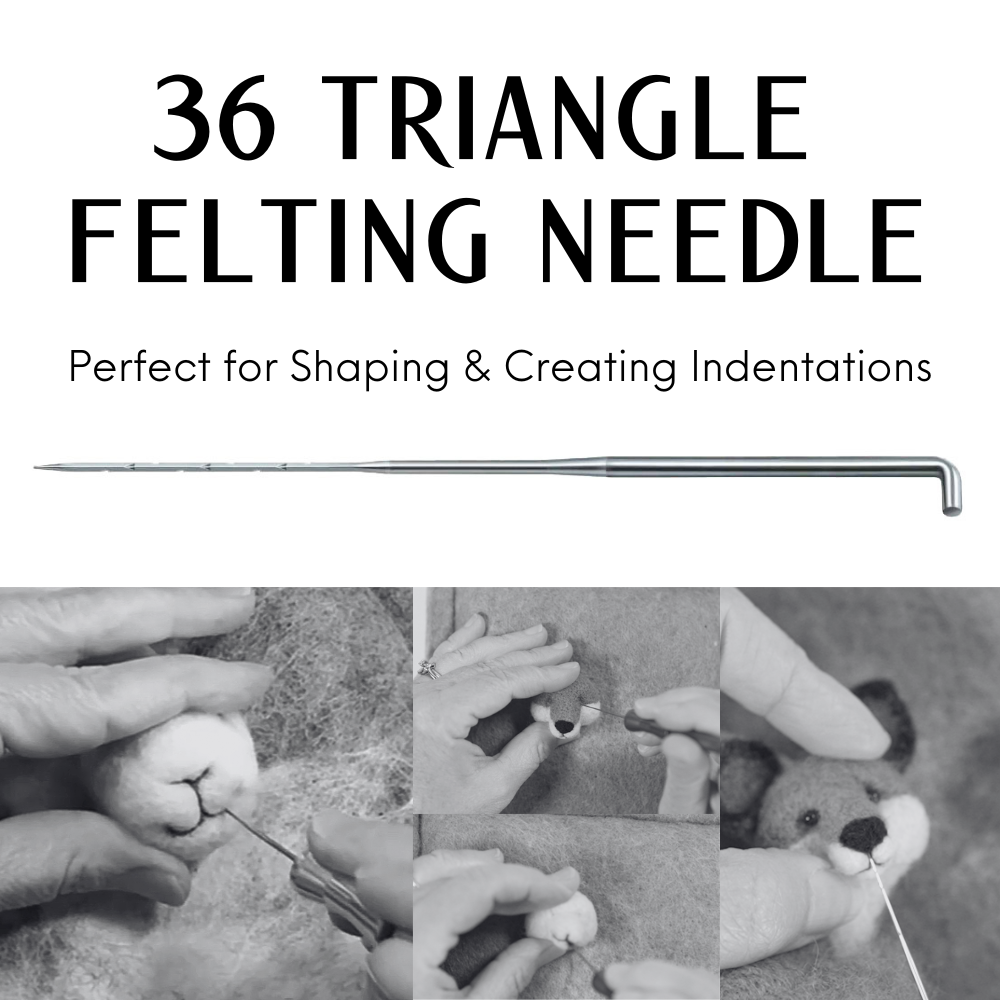
A felting needle doesn’t have an eye for thread, and it doesn’t work like a sewing needle. Instead, it has tiny barbs cut into the shaft.
Those barbs are what make needle felting possible.
Felting Needles Were Designed for Industry
Felting needles were originally developed for industrial needle-punching machines.
In those machines, large numbers of needles repeatedly move through layers of fiber to create nonwoven materials and felt.
The same basic principle is happening when we needle felt by hand—just on a much smaller scale.
The Groz-Beckert video below is a great way to see that process in action.
[Keep your Groz-Beckert industrial video here.]
What Happens When the Needle Enters the Wool?
Near the working end of a felting needle are tiny barbs.
As the needle moves into the wool, those barbs catch some of the fibers and carry them farther into the mass of wool.
When you pull the needle back out, the fibers are not simply lifted back to where they started. Repeated poking moves and entangles the fibers more and more.
Wool itself also helps this process because the surface of each fiber has microscopic overlapping scales.
As the fibers become entangled and compressed, the wool begins to hold together.
The more you felt an area, the:
- denser it becomes
- firmer it becomes
- smaller it becomes
- more defined the shape becomes
That is how a loose handful of wool can gradually become a solid three-dimensional sculpture.
Why Do Felting Needles Come in Different Shapes?
The working end of a felting needle is not always the same shape.
You may see needles described as:
- Triangle
- Star
- Cross Star
- Crown
- Reverse
Those names refer to the shape and arrangement of the working surfaces and barbs.
Different needle designs move fiber in different ways.
For example, I use a 36 Star for a lot of shaping and firming because it moves our wool efficiently. A finer needle can be useful later for surface work or detail, while a reverse needle works in the opposite direction and can pull fibers outward to create a fuzzy or furry surface.
So the question isn’t simply, “What gauge is this needle?”
The shape and barb placement matter too.
What Does Needle Gauge Mean?
Gauge refers to the thickness of the needle.
One thing that can be confusing is that the numbers work backward:
The higher the gauge number, the finer the needle.
A 36 gauge needle is heavier than a 40 gauge needle.
That means a coarser needle can often move more fiber and shape wool more aggressively, while a finer needle is better suited for refining and finishing.
Why Felting Needles Break
Felting needles are sharp, but they are also brittle.
They are meant to move straight into the wool and straight back out.
If the needle goes into the wool at one angle and is pulled out at another, sideways pressure can bend or snap it.
That is one of the most important habits for beginners to learn:
Straight in. Straight out.
Also keep your fingers out of the path of the needle. A felting pad or cushion gives you a safe surface to work against and protects both your table and your hands.
Can One Needle Really Make a Sculpture?
Absolutely.
A single felting needle can do an amazing amount of work.
You can use it to:
- build firm shapes
- join pieces together
- refine proportions
- add facial features
- attach surface wool
- create texture
- shape tiny details
Multi-needle tools can speed up larger areas, and specialty needles are useful for certain jobs, but you can create an entire sculpture with one good needle.
That is one of the things I love about needle felting.
The tool is incredibly simple.
What you can create with it is not.
Watch the Felting Process Up Close
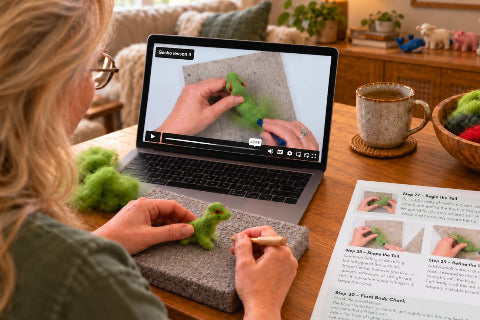
The second video below shows me needle felting a small amount of wool so you can see the process happening by hand.
Watch how the loose fibers gradually become more compact as the needle moves through them.
The More You Understand the Needle, the Easier Felting Gets
Once you understand what the barbs are doing, a lot of needle felting starts to make more sense.
Why does one needle shape the wool quickly while another barely seems to move it?
Why does the sculpture get smaller as it becomes firmer?
Why do needles break when they are twisted sideways?
Why does a different needle suddenly make a stubborn area easier?
It all comes back to how the needle interacts with the fiber.
And once you understand that relationship, you can stop simply poking wool and start using the needle more intentionally.
Lorem ipsum dolor sit amet, consectetur adipiscing elit, sed do eiusmod tempor incididunt ut.