


4 Needle Felting Tips That Save Time, Money & Frustration
4 Needle Felting Tips That Save Time, Money & Frustration
I started needle felting in 2006, and much of what I know today came from simply doing it—a lot.
Over the years I’ve spent thousands of hours with wool and a felting needle in my hands. Along the way, I’ve experimented with different tools, tried things that didn’t work, broken plenty of needles, and gradually figured out ways to make the process easier.
Some of the smallest changes have made the biggest difference.
Here are four things I wish I had figured out much sooner.

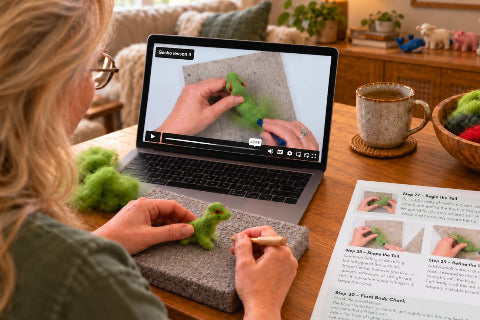
1. Use a Wool Felting Pad Instead of Foam
For years, I needle felted on upholstery foam.
It worked, but eventually the foam would break down, develop holes, and need to be replaced.
I wanted something that would last longer and felt better to work on, which eventually led me to wool felting pads.
Once I switched, I didn't want to go back.
A firm wool pad gives me a good surface to work against without all the little pieces of deteriorating foam. It also lasts much longer when cared for properly.
Today, the Bear Creek Felting wool pads I use and sell are made from wool and come in several sizes depending on the type of project you're working on.
If you're still felting on a piece of foam that is falling apart beneath your project, upgrading your work surface is one of the easiest changes you can make.

2. Give Your Fingers Something Better to Hold
For a very long time, I held a bare felting needle between my fingers.
Because I often felt for hours at a time, that tiny needle wasn't particularly comfortable.
I experimented with all kinds of solutions.
My husband made wooden holders for me.
I tried coating the end of the needle.
I even figured out how to turn an old pen into a surprisingly comfortable single-needle holder.
The pen idea worked well enough that I used it for years.
Then one of my Bear Creek Needle Felting Academy members suggested a different single-needle holder.
I tried it—and loved it.
It gave me the comfortable pen-like grip I wanted while solving the biggest problem with my homemade version:
Changing the needle is much easier.
I replace my heavily used felting needles fairly regularly, so being able to quickly remove one and insert another makes a big difference.
Sometimes the best tool isn't complicated. It simply needs to make the thing you're already doing easier.

Lorem ipsum dolor sit amet, consectetur adipiscing elit, sed do eiusmod tempor incididunt ut.


