
How to get a Smooth Finish Needle Felting
How to Reduce Fuzz in Needle Felting: Tips for a Smooth Finish
One of the questions I hear most often from beginning needle felters is:
“Why is my needle felting so fuzzy?”
If you're looking at your project and seeing loose fibers, flyaways, or an overall hairy surface, you're not necessarily doing anything wrong.
Wool is supposed to look like wool.
And some needle felting styles intentionally leave a soft or textured surface.
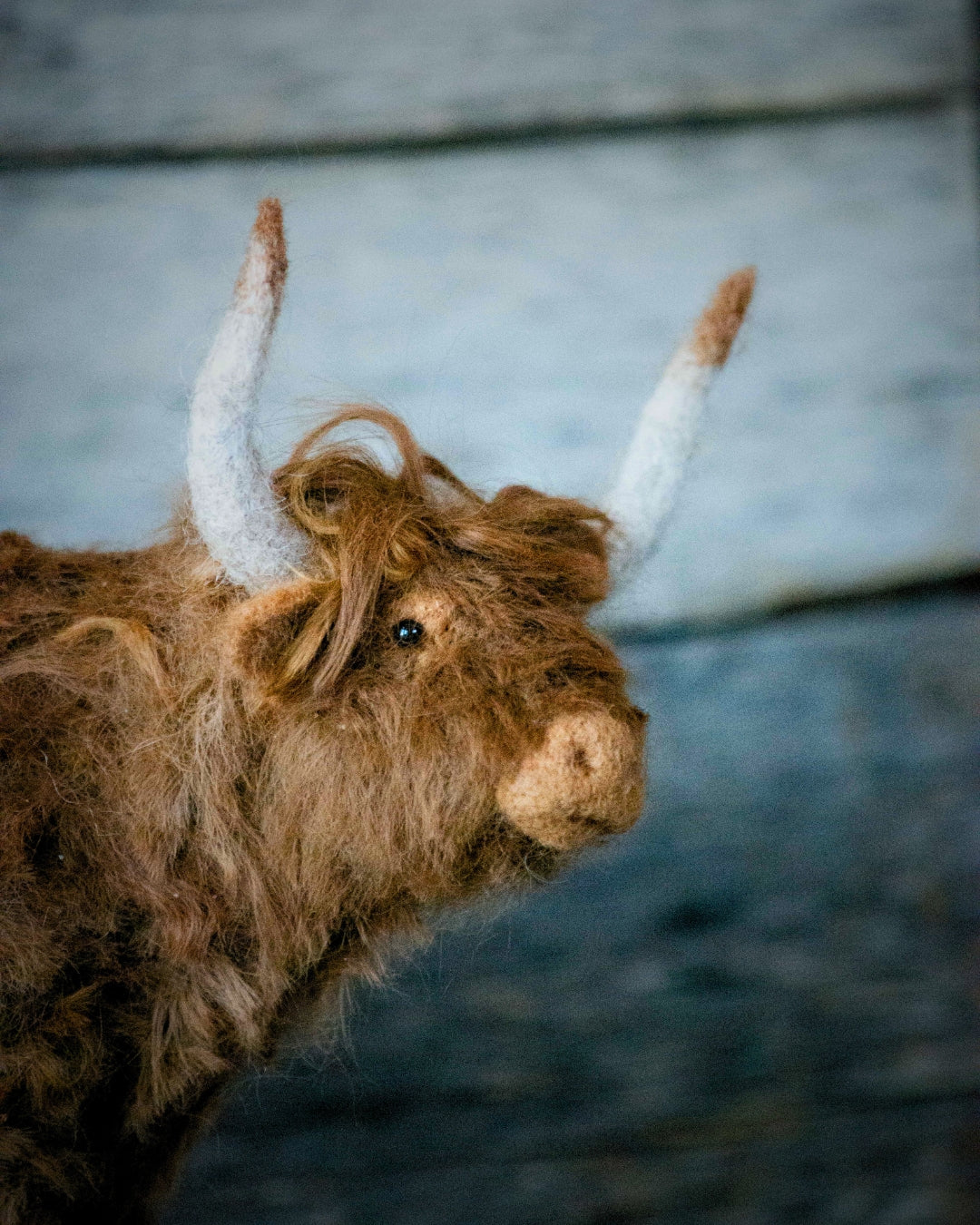
But if you're trying to create the firm, smooth animal sculptures that I make, there are several things that can make a big difference.
After years of raising sheep, processing wool, teaching needle felting, and sculpting with many different types of fiber, I've found that a smooth finish comes down to four things:
the wool, the firmness of the sculpture, the needle, and your finishing technique.

1. Start With Wool That Works for the Finish You Want
Wool choice makes a tremendous difference.
Different breeds—and even different sheep within the same breed—can behave very differently under a felting needle.
Some fibers grab quickly, compact easily, and disappear neatly into the surface.
Others are smoother, finer, longer, or more wiry and may take considerably more work to create the same finish.
This is one reason I care so much about the wool we produce at Bear Creek.
Our flock has a strong Romney foundation along with other genetics I have chosen for the wool characteristics I like for felting. I now process that wool in our own Bear Creek Felting fiber mill in Fort Ransom, which gives me even more control over how the fiber is prepared before it reaches my felting table—or yours.
What About Different Breeds?
Romney and Romney-based wool have long been favorites of mine for firm three-dimensional sculpture because they grab well and can create a nice, clean surface.
Corriedale is another wool I have grown to really appreciate. I now have Corriedale sheep and crosses in my flock, and I love the fiber when I process it for the kind of felting I do.
Merino is much finer and softer. It can absolutely be needle felted, but for my firm sculptural style I find it slower to build and refine than the wool I normally use.
Icelandic has two distinct fiber types—the soft thel and longer tog. The thel can felt beautifully, while lots of longer tog in the preparation can create a much hairier surface.
The biggest lesson I've learned is:
Don't judge wool by the breed name alone.
The individual fleece and the way the fiber is prepared matter too.
2. Make the Sculpture Firmer
This may be the biggest reason I see beginner projects staying fuzzy.
The sculpture simply isn't finished being felted yet.
When there is still a lot of air inside the shape, fibers remain loose and have plenty of room to move around.
As you continue felting, the wool becomes denser.
The shape gets smaller.
The surface becomes firmer.
And more of those loose fibers become incorporated into the sculpture.
If you're trying to achieve the style of felting I teach, your finished sculpture should feel quite firm, not soft and squishy.

Build Firmness as You Go
I prefer to work with relatively small amounts of wool and gradually build the sculpture.
Firm the base shape before piling on more wool.
Add thin layers when you need more volume.
Then felt those layers thoroughly into the surface before adding the next.
If you create a large, fluffy shape first and try to make it firm later, you're giving yourself a lot more work.
And don't save all the surface refinement for the very end.
Smooth and firm the sculpture throughout the process.

3. Use the Needle That Matches the Job
Felting needles aren't interchangeable.
Different gauges, shapes, and barb configurations move wool differently.
For much of my sculptural work, I love a 36 Star because it moves wool efficiently and helps me build firm shapes.
But the needle that is wonderful for building the sculpture may not be the needle I want for every finishing step.
As the wool becomes firmer, a finer needle can help refine the surface without creating the larger holes or movement that you might get from a more aggressive needle.
The important thing is to understand what your needle is doing.
If you've been poking and poking but the surface isn't improving, ask yourself:
- Is the sculpture actually firm enough?
- Is this needle too aggressive for the finishing stage?
- Has my needle been heavily used and become less efficient?
- Would a finer needle work better on this dense surface?
Sometimes switching needles makes a surprising difference.
4. Add Very Thin Layers for Final Refining
If your sculpture is firm but the surface still isn't as smooth as you'd like, try adding a very thin layer of wool over the area.
And I mean thin.
You're not trying to make the sculpture larger.
You're giving yourself a fresh layer of fibers that can be carefully felted into the existing surface.
This can be especially helpful where added pieces of wool have left visible lines or where you have spent so much time working an area that the underlying wool has become very dense.
A whisper-thin layer can give you something new to work with.
Felt it thoroughly into the sculpture until the transition disappears.

5. Don't Expect the Needle to Eliminate Every Single Hair
There comes a point when you can stop poking.
Even on a very firmly felted sculpture, you may still have an occasional stray fiber.
That doesn't mean you need another hour of felting.
For my finished sculptures, I sometimes use small sharp scissors to carefully trim individual flyaways.
For larger, extremely firm surfaces, I have also used a small beard trimmer very carefully.
The key word is firm.
I would never take a trimmer to a soft or loosely felted sculpture. It can pull at the fibers instead of simply trimming the surface.
Most of the smoothness should come from your wool and felting technique.
Trimming is simply the final cleanup.
I don't use glue, sprays, or other coatings to make my sculptures smooth.
They're still wool.
How Smooth Should Needle Felting Be?
That depends entirely on the look you're trying to create.
A sheep may need curly locks.
A long-haired animal may need wispy fibers.
A fuzzy little creature may look better with texture.
There isn't a rule saying every needle felted sculpture should be perfectly smooth.
But if your goal is the dense, detailed style of sculpture that I create, the basic formula is:
Use wool that felts willingly.
Build the sculpture firmly.
Use the appropriate needle for each stage.
Refine with thin layers.
Trim only what remains.
And above all, give it time.
A finished surface usually doesn't come from one special needle or one secret trick.
It comes from gradually building and refining the wool until the sculpture reaches the firmness and finish you're looking for.
Share
Shop this Post
Lorem ipsum dolor sit amet, consectetur adipiscing elit, sed do eiusmod tempor incididunt ut.